
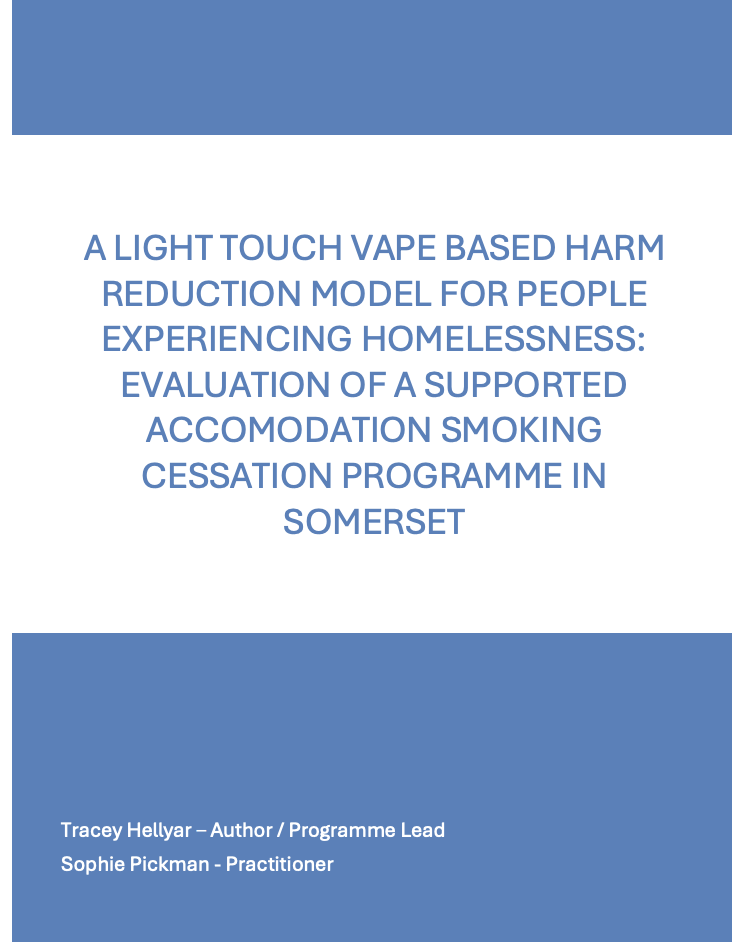
People experiencing homelessness face some of the poorest health outcomes in society and often encounter significant barriers when accessing traditional healthcare services. High smoking prevalence, complex health needs, substance use, mental ill health and housing instability can mean that opportunities for preventative intervention are frequently missed. This evaluation explores how Somerset Council's stop smoking service adapted its approach to better meet the needs of this underserved population.
The Light Touch Homeless Project embedded support within trusted supported accommodation settings, working in partnership with housing and homelessness organisations. Rather than expecting individuals to attend appointments or engage with traditional healthcare pathways, the programme provided a flexible, low-barrier model centred on accessible vape-based harm reduction support and trauma-informed practice. The aim was to reduce barriers to engagement and make it easier for residents to access support in environments where they already felt safe and supported.
The evaluation found that the model was both feasible and engaging. Of 31 clients included in the evaluation, 30 completed
the 12-week programme offer, demonstrating high levels of retention within a population often considered difficult to engage. At four weeks, over half of participants achieved a positive smoking outcome, indicating that meaningful behaviour change can be achieved when services are adapted around people's circumstances rather than expecting people to fit traditional models of care.
Importantly, the learning extends beyond smoking cessation. The project demonstrates how housing settings can act as effective platforms for health improvement, enabling preventative healthcare services to reach people who may otherwise have little or no contact with mainstream health services. Success was supported by strong partnership working between public health, housing providers and support staff, who played a crucial role in facilitating engagement and maintaining access to support.
The evaluation also identified areas for service development, particularly around supporting residents when they move on from accommodation. Learning from the project has already informed changes to improve continuity of support, including enhanced follow-up arrangements and self-referral options for residents leaving supported housing.
This work provides practical, transferable learning for housing providers, public health teams, NHS organisations and commissioners seeking to reduce health inequalities, improve access to preventative healthcare and develop effective cross-sector partnerships for underserved communities. While tobacco dependency treatment was the intervention delivered, the wider lesson is that meeting people where they are can create opportunities for health improvement that might otherwise be missed.
You can read and download the full project evaluation HERE