
Pre-pilot survey
A survey was conducted before the pilot started to assess the opinions of clinicians who discharge patients with a catheter. The priorities identified regarding the discharge process were:
• An alternative to telephone registration is needed
• An out of hours service is required
• Time
• Ease of use and accessibility
• Delivery confirmation
Pilot
The pilot was conducted over 21 weeks from 5th September 2025. Eleven clinicians used Vyne Online during the pilot, three from the Day Surgery Unit and eight from the Urology Nurse Specialists’ team. Over the course of the pilot, 129 interactions with Vyne online were captured. The data collected were analysed against the priorities identified above.
• An alternative to telephone registration is needed – Vyne Online offered this alternative.
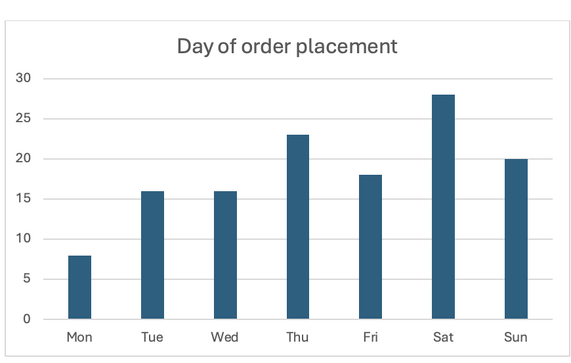
• An out of hours service is required – analysis of the captured data revealed that clinicians were able to use the system outside of conventional office hours. Almost a quarter of orders (31/129) were placed before 9am or after 5pm demonstrating that the flexibility provided by an online system is beneficial to have. Clinicians used the system at weekends 37% of the time, mainly on Saturday, accounting for over 20% of the activity.
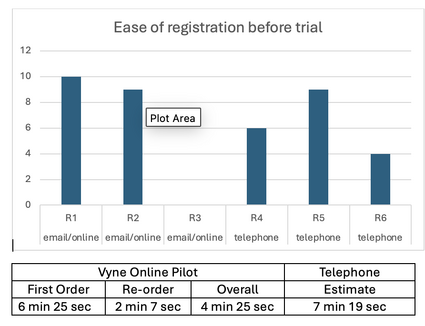
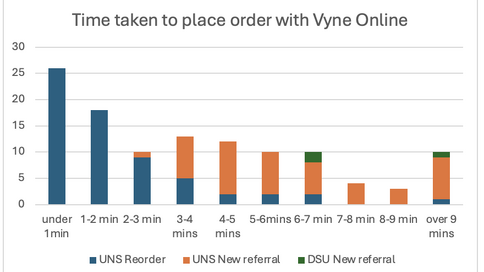
• Time – the time taken from the start of an interaction with Vyne Online to its completion was recorded and compared with an estimated time to interact via telephone of 7 minutes and 19 seconds, based upon average industry queue times and observed internal call durations. This estimate closely matches with the observations of the pre-pilot survey of 7 minutes and 40 seconds.
The data was spilt between first order and registration, and subsequent re-ordering. The three longest and shortest interactions of each type were discounted as outliers and the mean of the remaining ordering times were calculated. Overall, 82% (n=106) of all interactions captured took less than 7 min and 19 seconds. During the pilot, almost 6.5 hours (23385 seconds) were saved in the process of registering and placing orders for patients.
• Ease of use and accessibility – the two click reordering process offered allowed subsequent orders to be placed in as little as 13 seconds and on 29 occasions, the process took under a minute.
Post-pilot survey
After using Vyne Online, clinicians were invited to complete a questionnaire with 27% (n=3) responding. All respondents found using Vyne Online to be a “Very Positive” experience with the two users who expressed a preference stating they “Strongly Prefer Vyne Online” when comparing it to their previous method of registration and would choose to continue to use Vyne Online in the future.
• Time – All respondents felt using Vyne Online was quicker than their previous process
• Make it easy to use and accessible – All respondents felt that the training they received to use Vyne Online was sufficient to enable them to use the platform confidently, with one respondent mentioning that the ease of use and user-friendliness were two key aspects of the platform
• Delivery confirmation – All respondents were “Much More Reassured” with the traceability provided by Vyne Online versus their previous method of registration and “Very confident” that their registration and order were taken care of.
• Patient use – All respondents answered “Yes, definitely” when asked if they felt Vyne Online would be a valuable tool for patients.
Summary
The pilot of Vyne Online has demonstrated that it meets all priorities identified by clinicians who register and place orders for patients in UHCW.
The platform offers a viable, easy to use, alternative to the telephone which operates effectively outside of traditional working hours and reduces the administrative burden when undertaking these essential activities.
Furthermore, it provides reassurance to the clinician that orders have been completed and is anticipated to be a great tool for patients to use once discharged.