
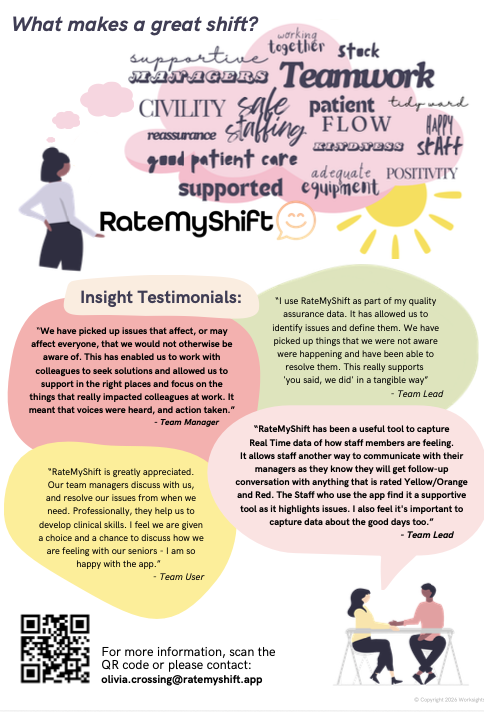
RateMyShift is a real-time staff feedback platform, designed by nurses for health and social care teams. It turns how people feel at the end of a shift into insight their managers can act on. Staff are asked one question, ‘how do you feel after your shift?’, choose a face from a Likert scale, and can add a confidential comment; where a shift is rated negatively, the dashboard prompts the manager to follow up. It fills a gap: understanding how staff feel, shift by shift, is fundamental to good care, yet the tools the system relies on- the annual Staff Survey, pulse checks, exit interviews- are anonymous, infrequent and arrive months too late. With nursing turnover around 10%, many leave before survey results are published.
Confidential, not anonymous
Anonymous feedback cannot be acted on for the person who gave it; RateMyShift is confidential instead, so a difficult shift can prompt a real, supportive conversation. Real improvement happens when feedback is trusted, contextual and actionable. Above team level, data is aggregated and anonymised, giving organisations a thematic picture without enabling individual performance monitoring.
The central finding: follow-up drives engagement
Across pilots in maternity, community, out-of-hours and acute settings (2023–24), staff participation tracked manager follow-up, the point at which the organisation closes the loop. At University Hospitals Plymouth, over three months, as the average time to follow up lengthened from 3.5 days to 5 to 10, the proportion of signed-up staff still rating their shifts each month fell in step, from 82% to 62% to 45%. Sign-up held steady; what changed was whether people kept taking part, which followed how quickly managers responded.
Two Sirona Care and Health community services showed the same from another angle. In the out-of-hours service, managers followed up in a median of four days and completed 96% of prompted follow-ups; 90% of shifts were rated positively. In the in-hours service, follow-up averaged around two weeks, 78% were completed, positive ratings were lower at 77%, and participation declined over the pilot. The services do different work, so this is not like-for-like, but the direction is consistent.
Why this matters
This matters beyond any single pilot. The Francis Report (2013) set out what happens when organisations stop listening to staff; the Ockenden (2022) and Darzi (2024) reviews reinforced that leaders need timely, honest insight into how teams are coping and the means to act. Confidential, real-time feedback is one practical route.
What the conversations surfaced
The issues staff raised most often were workload pressure, staffing shortages, communication and personal wellbeing. It also captured what makes a good shift, teamwork, civility, safe staffing, support and kindness, giving managers something to reinforce, not only problems to fix. But the value lay less in the themes than in the conversations they prompted. An internationally trained nurse rated a shift red after a busy day; her follow-up revealed that where she had trained, asking for help was not the norm, and with her charge nurse’s support she learned to delegate. A healthcare assistant’s red rating surfaced that he had not been told a patient was arriving, and had not felt able to ask. A manager realised from her data that she rarely saw two or three of her team, whose shifts never coincided with hers, and began making time to check in.
What we learned
RateMyShift does not work in isolation. Where it was introduced without manager briefing, support and coaching, follow-up rates were lower and engagement declined; that wrap-around is now built into every deployment. A common barrier is resource: organisations assume acting on real-time data would demand capacity they do not have. The trials suggested the opposite. With coaching in place, teams used quick follow-ups to resolve issues locally themselves, while leaders gained oversight to direct help where it was most needed, shifting from reactive firefighting to proactive action, and saving time rather than adding to it. The technology surfaces the signal; the response, supported, delivers the benefit.
Where we are now
RateMyShift has completed its early pilot phase and is developing Version 2. Current NHS deployments in England and Wales are under independent evaluation, building evidence of impact and return on investment for staff, teams and organisations.
You can find out more HERE
Olivia Crossing (Sister, University Hospitals Bristol and Weston) and Annie Taylor (Deputy Associate Director of Patient Care, Somerset NHS Foundation Trust) are nurses and co-founders of Worksights Ltd.
Contact: [email protected]